God is obviously non-binary
Happy Pride, y'all!

I normally don’t feel a particular need for these posts to be “relevant” or timely. I write when I can (rarely) about whatever is stirring in me. Yet it also felt like it would be a travesty to allow Pride Month to pass by without some kind of post, mostly because it feels as if there has been a resurgence of anti-LGBTQ sentiment among many Christians over the last few years. For a minute there, it seemed like we were moving, however slowly, toward a more welcoming, more inclusive, that is, more Christ-like church. Even if it took the Spirit dragging us kicking and screaming to a place of deeper welcome, she was moving us nonetheless.
It seems, however, that whenever progress is made, regressive forces reemerge all the more powerfully (and nastily). While I would like to think of this as evidence of the extinction event of the hate-filled, power-hungry forms of evangelicalism we have become so accustomed to, I also do not think harmful ideas will simply disappear on their own.
So I wanted to address two basic issues that I have heard Christians grappling with lately. First, the gender of God; and, second, crappy readings of the Bible used to justify anti-queer sentiments, specifically the story of Sodom and Gomorrah and its afterlives. There is so much more that could be (and has been) written, but I offer this as a nudge especially for Christians who believe the Bible to be fundamentally incompatible with affirming the place of LGBTQ people in the church. I also hope this will be a gentle reminder of sorts that the Bible is so much weirder than we often allow—and its weirdness is one of its biggest gifts.
I think it’s worth mentioning that most of the ideas below are not necessarily mine. This is, it turns out, rather basic biblical scholarship that can be gleaned from just about any critical study Bible/commentary. I would not even know where to begin to cite secondary sources because they are legion.
The Gender of God
Many Christians are up in arms at the moment because of James Talarico’s statements that God is best understood as non-binary with respect to gender. This means, very simply, that God is neither male nor female, but is in some way beyond our gender categories. This should be a rather simple, even “orthodox”1 statement.
Of course God is neither male nor female. Of course God is beyond all the categories we have created for organizing and categorizing ourselves into neat little boxes.2 Of course it is absurd to suggest otherwise, or to argue with your whole chest that God is and must be a man. Unless, that is, someone out there would like to comment on the size of God’s….never mind. Again, the idea is absurd on its face.
What is important to recognize, however, is that those who insist on the maleness of God are doing so for political reasons, not biblical. Talarico’s statement is also obviously political, but, I humbly suggest, it is also far more faithful to the larger biblical witness of the God who is simply beyond our silly little categories.
The whole point of Gen. 1:27, for instance, seems to be that all human genders reflect the image of God, which can really only be the case if God is beyond our understanding of gender. In other words, within the very being of God is the potential for any and all gender expressions, and all of them reflect God’s image equally. I struggle to see any sense of hierarchy or superiority ascribed to any particular gender as it pertains to God’s image and likeness here.
While many love to point to Genesis 1 as some kind of evidence that there are only two genders and that gender must be understood as a reductive binary, to claim that the binaries throughout Gen. 1 are hard and fast is to miss the point entirely.
Commentators on Gen. 1 have long observed the use of a literary device known as merism throughout the chapter. Merism, very simply, uses two contrasting parts as an expression of the whole. Think, for instance, of the biblical idea of Jesus being the Alpha and Omega, the beginning and the end. Do Christians think Jesus was there at the beginning, and will be there at the end, but is nowhere to be found in the middle? Of course not! The merism of Alpha and Omega is meant to suggest that Christ is present throughout all time.
Even conservative scholars/preachers/readers have long recognized the obvious merism with which Genesis begins, “In the beginning when God created the heavens and the earth…”3 God, in other words, created the heavens, the earth, and everything in between—God created everything that exists, even those things that do not fit neatly into the categories of “the heavens and the earth”
Later, God separated the waters from the dry land: “God called the dry land Earth, and the waters that were gathered together he called Seas.” Do we think the author of Genesis thinks God did not make swamps, marshes, and other ecotones that do not neatly fit into the categories of dry land or sea?
Likewise, God created light and dark, with a corresponding celestial body to govern each. Yet, did God not also make sunrises, sunsets, twilight, and all expressions of light and dark that exist along a vast spectrum of light? Perhaps the suggestion from my anti-LGBTQ siblings is that sunsets are an abomination?
Why, then, if we can see the sacred, generative merisms throughout Gen. 1—which point us to the expansive wonder of creation—would we stop short when we arrive at the final merism of the chapter?
So God created humankind in his image,
in the image of God he created them;
male and female he created them.
To be clear, I am not suggesting that the author of Gen. 1 had transgender/non-binary/gender fluid folks in mind when writing this poetic account of creation. Those are modern categories, not ancient. I am suggesting, however, that there are faithful biblical resources for affirming the beauty, value, and belovedness of all people, of all gender expressions. The merisms of Gen. 1 practically demand it!
Moreover, the way we think about God is inextricable from the way we think about ourselves, and vice versa.4 In other words, there is no gender expression that does not reflect the image of God. When we restrict the image of God to certain gender expressions, we cut ourselves off from the possibility of experiencing the God who is truly beyond, yet intimately with us.
But, you may object, it is still the case that the Bible almost exclusively refers to God using male language and pronouns. And that’s mostly true, but not entirely (by the way, don’t you love how interested in pronouns people suddenly become when it comes to God’s gender?). There are plenty of biblical examples of God and Jesus being depicted with maternal/feminine language (Google is your friend!). We should not be surprised that people in patriarchal cultures default to the masculine when it comes to their deity, nor should we allow our imaginations to be limited by their language.
Finally, both Hebrew and Greek are gendered languages, meaning that all nouns have a built-in gender, which has primarily to do with how the words function, not the actual gender of the noun in question. It is not necessarily the case, in other words, that the gender of a particular noun is meant to communicate anything about the actual gender of the thing.5 Again, it primarily has to do with function. This is especially helpful in a language like Greek, in which word order means almost nothing. A noun’s pronoun, article, etc. could be on the opposite end of the sentence or clause, but we can determine what goes with what by matching the gender (and number and case).
So, yes, the noun for God is masculine in both Hebrew and Greek. But the noun for Spirit is feminine in Hebrew and neuter (non-binary, perhaps?) in Greek.6 No matter how we slice it, nothing about the language of the Bible requires us to insist on the maleness of God, quite the opposite in fact.
Whatever else you may think about James Talarico, he is right on this. God is obviously non-binary.
Your Sister Sodom
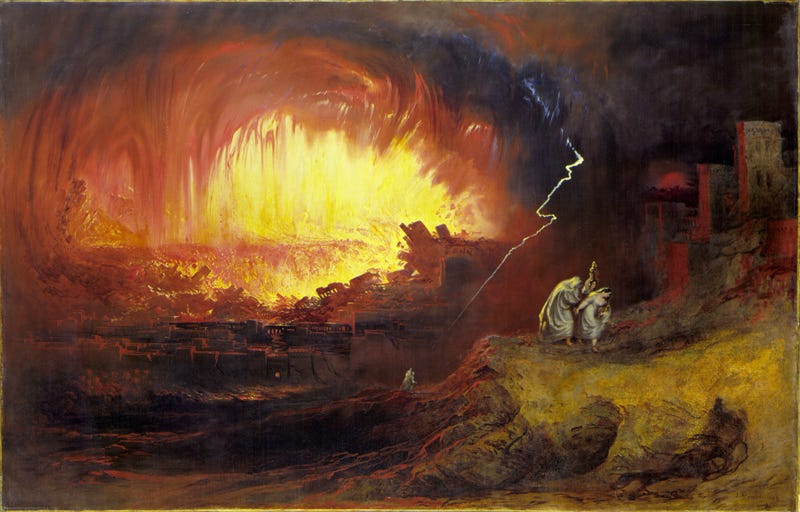
The account of the destruction of Sodom and Gomorrah from Gen. 19 has long been one of the favorite so-called “clobber texts” (i.e., passages of scripture some Christians use to clobber their queer neighbors). It’s a weird story on many fronts, even weirder to place at the center of the debate about the place of queer folks in the church because it has absolutely nothing to do with what we think of as homosexuality.
For the sake of space, I won’t rehash the whole account (go read Gen. 19 for yourself!). I will simply point out that most Christians today seem to have no clue how important it is that the two men who came to Lot’s house were explicitly identified as angels. The “sin” here has nothing to do with them being men, and almost everything to do with them being angels, but I’ll return to this point in a moment.
We should also notice that when other biblical writers mention this account, they say nothing about homosexuality specifically, and often don’t mention sexuality at all. Ezekiel, for instance, writes, “This was the guilt of your sister Sodom: she and her daughters had pride, excess of food, and prosperous ease, but did not aid the poor and needy. They were haughty, and did abominable things before me; therefore I removed them when I saw it.” (16:49-50). More often than not, the story is used as a cautionary tale for the kind of destruction God can reap on those who are inhospitable, gluttonous, lacking in compassion for the destitute, etc., not an explicitly anti-gay screed.
One of the few places that does mention sexuality explicitly is the Epistle of Jude, but (and this is an enormous but), it says the exact opposite of what most Christians seem to think it says. Let’s compare a few translations of Jude 7:
Likewise, Sodom and Gomorrah and the surrounding cities, which, in the same manner as they, indulged in sexual immorality and pursued unnatural lust, serve as an example by undergoing a punishment of eternal fire. (NRSV)
In a similar way, Sodom and Gomorrah and the surrounding towns gave themselves up to sexual immorality and perversion. They serve as an example of those who suffer the punishment of eternal fire. (NIV)
just as Sodom and Gomorrah and the surrounding cities, which likewise indulged in sexual immorality and pursued unnatural desire, serve as an example by undergoing a punishment of eternal fire. (ESV)
Even as Sodom and Gomorrha, and the cities about them in like manner, giving themselves over to fornication, and going after strange flesh, are set forth for an example, suffering the vengeance of eternal fire. (KJV)
The italicized words are most at issue here. I can understand how someone who was has heard all their life that the mortal sin of Sodom was gay sex would read these translations and naturally come to the conclusion that, yep, God really, really does not like homosexual acts. The problem, however, is that all these euphemistic translations completely obscure the actual words the author chose.
Rather, the Greek says they pursued “other flesh” (or sarkos heteras). The word from which we derive our prefix hetero- (i.e., other, not same) is right there in the Greek: heteras.7 In case it is not yet clear, if the author of Jude intended this as a clear denunciation of homosexuality or even homosexual acts, he would have used the adjective homos, not heteros. Again, it says the exact opposite, not that they pursued same-sex attraction, but that they went after “other flesh.” But what on earth could “other flesh” mean? Sex with angels, of course!
This is one of those weird features of the Bible of which most Christians today are unaware. There is a surprising amount of concern throughout numerous biblical (and contemporaneous non-biblical) texts about humans being copulating with angels. This begins, of course, with the flood narrative of Gen. 6, which describes “the sons of God” coming down to earth to marry and have sexual intercourse with earth women who then give birth to a race of giants known as the Nephilim. All of this is the backdrop to the eventual flood that God sends.
But what does this have to do with Jude? One of the more fascinating features of Jude is that it quotes directly from another text known as 1 Enoch, which was wildly popular among many Christians and Jews for centuries. The author of Jude not only quotes from 1 Enoch directly, but even refers to it as prophecy. 1 Enoch is a complicated, composite text. The first thirty-six chapters, known as The Book of the Watchers, is, among other things, an expansion of the Gen. 6 legend, detailing the fall of the angels who fathered the Nephilim and all the terrible things those fallen angels taught to humanity (e.g., metallurgy and—gasp!—cosmetics).
We even hear echoes of this tradition/concern in one of Paul’s letters to the churches in Corinth. He tells them that women need to pray with their heads covered, “because of the angels.” (1 Cor. 11:10). It’s a strange line, isn't it? But it immediately makes sense when we put it in the context of this larger concern of angel sex—a concern I assume none of us shares, but was kind of big deal for many of these ancient authors.
The story of Sodom and Gomorrah is not what venomous preachers have made it out to be, and, I promise, neither are the other clobber texts. To the extent that it has anything to do with sexuality, it’s about angel sex, not homosexuality—and certainly not about consensual sex between two adults in a committed, loving relationship. To use this text as a bludgeon against LGBTQ folks is not only to do a kind of violence to the text, but, more importantly, to participate in violence against fellow bearers of the divine image. Even worse, many of us still call that violence holy.
I talk regularly with Christians who want to be allies but who feel out of their depth when it comes to the Bible and LGBTQ inclusion. If you are one of those folks who feels like you don’t know the Bible well enough to know how to enter these conversations with non-affirming people, perhaps you can take some comfort in recognizing that they probably don’t either—they just think they do.
If you know love, and how to love, you have understood the Bible better than most. Love is always moving us in the direction of a more expansive welcome, ever-widening arms. Trust that instinct. You can trust your big, beautiful heart to lead you in the direction of love, which we claim is another name for God.
The Bible is not your weapon
So, all this is to say, please, literally for the love of God, please stop using the Bible as a weapon against queer people. I can almost guarantee, no matter the text you are reading on this issue, it does not say what you think it says. It is always more complicated. It always requires context, nuance, and care, most of which I rarely see in conversations/sermons/social media rants from more conservative-leaning folks, at least on this issue.
It has always struck me as strange how many Christians will lean on the “God’s ways are not our ways” cop-out when it comes to questions like how a supposedly loving God would willingly torture most of humanity for eternity; yet, when it comes to our sexual ethics, we insist our ways must be God’s ways. The church has done unbelievable damage as a result.
To any beloved LGBTQ folks who may have found your way here, I am so, unbelievably, incomprehensibly sorry. I am sorry for the ways too many Christians have treated you and made you feel as though you are anything less than one of the many expressions of the fullness of the image of God. I am sorry for the violence that has been done to you in the name of Jesus. I am sorry that we still have to have this conversation at all, that it took too many of us too long to realize the sheer depravity that is “love the sinner, hate the sin.”
Most of all, I am sorry for my own complicity in your pain. I do not blame a single one of you if you never want to set foot inside a church again. I understand that, for many, it is simply not worth the risk. I pray that you are finding healing from whatever harm Christians like me have caused you, and that, whatever else you believe or do not believe about God, that you know to your very core that you are indeed wonderfully made. Or, as God would say, “very good.”
Many Christians love to tell queer people, “God doesn’t make mistakes.” And it’s true; there is not a single mistake in your beloved body. The mistake has always been ours.

“Orthodox” should almost always go in scare quotes. More on that some other time.
Or, I have written elsewhere, “God…is not an object to be grasped or systematically theologized because whatever we mean by God has to be beyond our adorable little ideas, or it is not God.”
I won’t link it here, but even young earth creationist Ken Ham loves to point out the initial merism of Gen. 1. He thinks he helps his case somehow (it doesn’t).
As Mary Daly suggested a few decades ago, “If God is male, then the male is God.” Beyond God the Father, 19.
Think, for instance, of a word like la mesa in Spanish. Are all tables girls???
And don’t get me started on the doctrine of the Trinity. Given the whole three-in-one/one-in-three thing, what pronouns could possibly be more appropriate for God than they/them?
The adjective heteros in the feminine form here to match the feminine noun sarx (flesh), a wonderful reminder that the gender of words often has nothing to do with actual gender.
A great word. Grateful for the clarity of your writing. Greatfulness for the wierdness of scripture that matches the wierdness of the world. People have always been scared of weirdness, but when you get close to it it's the beauty and wisdom of God.
Thank you Sheldon for writing this article!♡